

Power Electronics Engineering Blog
Discover industry analysis, technical guides, component selection advice, and news from eMergy Tech specialists.
Choosing the right Aluminum Electrolytic Capacitors in 2026 is not simply a matter of selecting the largest capacitance. Real circuit conditions decide performance. A power supply may face sharp load changes, high ripple current, heat near a transformer, or limited board space. Each detail changes the best choice.
This guide compares general-purpose, low-impedance, high-ripple, snap-in, screw-terminal, polymer hybrid, and long-life designs. It examines capacitance, rated voltage, ESR, ripple-current capability, temperature rating, and expected service life. Datasheets remain essential. A capacitor marked 10,000 hours at 105°C may deliver a different lifetime at 70°C. Small details matter.
Experience matters here.
During practical evaluation, engineers should measure temperature rise and ripple current rather than trust labels alone. A compact capacitor may fit perfectly, yet fail early beside a hot heatsink. Conversely, a larger screw-terminal model may offer stronger endurance but require costly mechanical changes. Safety vent placement, polarity, insulation, and mounting orientation also deserve attention. IEC 60384-4 provides useful reference points, but compliance does not remove the need for application testing.
There is no universal winner.
This comparison aims to provide a reliable framework for engineers, purchasers, and maintenance teams. It also acknowledges an uncomfortable truth: product rankings can become outdated quickly. Manufacturers revise series, materials, and specifications. Therefore, verify current datasheets, approved substitutions, and sample performance before final selection. The best capacitor is the one that survives the actual electrical and thermal environment, not merely the one with the most impressive headline specification.
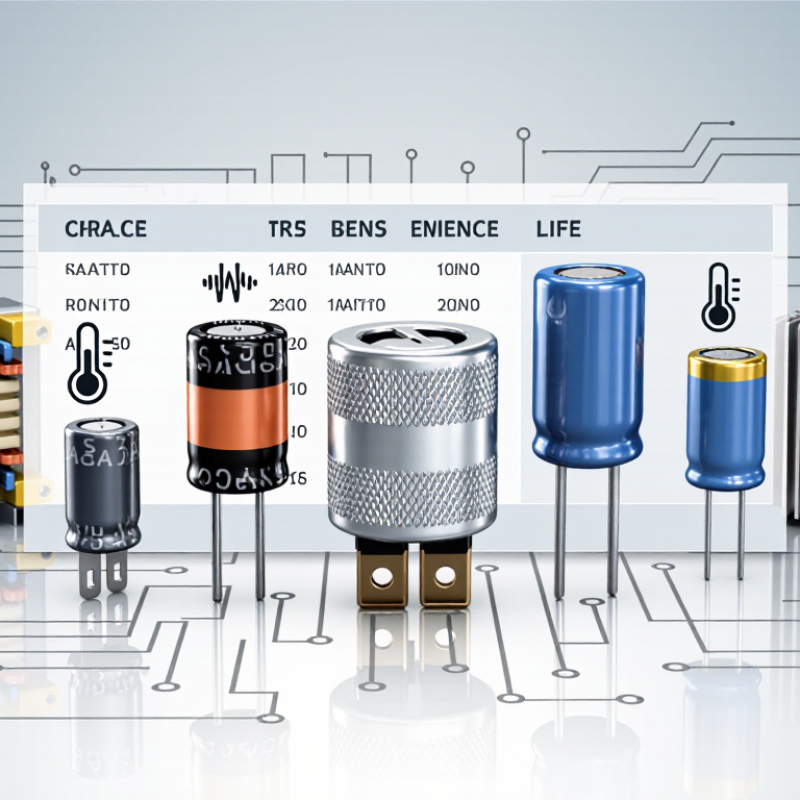
Aluminum Electrolytic Basics: Polarity, 6.3–630 V Ratings, and 1–10,000 µF
Aluminum electrolytic capacitors remain practical choices for smoothing, filtering, and energy storage. Their capacitance commonly ranges from 1 to 10,000 µF. Voltage ratings may span 6.3 to 630 V. Choose a rating above the circuit’s maximum working voltage, not just its nominal value.
Polarity matters. The marked negative lead must connect correctly, while the positive lead goes to the higher potential. Reverse voltage can cause leakage, heating, venting, or permanent failure. I also check ripple current, equivalent series resistance, temperature rating, and expected service life. A 1,000 µF capacitor is not automatically suitable because its ripple rating may be too low.
Different constructions suit different layouts. Radial parts work well on general circuit boards, while surface-mount versions save space. Larger snap-in or screw-terminal designs handle higher capacitance and power filtering. Non-polar aluminum electrolytics suit alternating or signal-coupling applications, but their electrical behavior differs from polarized types. A 6.3 V part may fit a low-voltage rail, yet a modest supply spike can leave little safety margin. In practice, I sometimes prioritize ripple performance over capacitance value, although this can increase size and cost. Selection is rarely perfect. Always verify the datasheet, polarity marks, ambient temperature, and actual circuit conditions before installation.
| Capacitor Type | Typical Capacitance Range | Common Rated Voltage Range | Typical Operating Temperature | Polarity | Main Characteristics | Typical Applications |
|---|---|---|---|---|---|---|
| General-Purpose Aluminum Electrolytic | 1–10,000 µF | 6.3–450 VDC | −40 to +85 °C or −40 to +105 °C | Polarized | Balanced cost, capacitance, voltage, and ripple-current performance. Suitable for ordinary filtering and energy-storage duties. | Power-supply smoothing, decoupling, consumer electronics, and control circuits. |
| Low-Impedance Aluminum Electrolytic | 10–10,000 µF | 6.3–100 VDC | −55 to +105 °C or −55 to +125 °C | Polarized | Lower ESR and impedance than general-purpose parts, improving transient response and high-frequency ripple handling. | Switch-mode power supplies, voltage regulators, computer power rails, and DC-link filtering. |
| High-Ripple-Current Aluminum Electrolytic | 47–10,000 µF | 16–450 VDC | −40 to +105 °C or −40 to +125 °C | Polarized | Designed with internal construction optimized for higher ripple current and longer endurance under thermal stress. | Inverters, motor drives, industrial power supplies, and rectifier output filters. |
| Long-Life Aluminum Electrolytic | 10–10,000 µF | 16–500 VDC | −40 to +105 °C or −40 to +125 °C | Polarized | Specified for extended endurance, often from approximately 2,000 to 10,000 hours at the rated temperature, depending on construction and load. | LED drivers, industrial controls, telecommunications equipment, and appliances. |
| Snap-In Aluminum Electrolytic | 100–10,000 µF | 160–500 VDC | −25 to +85 °C or −40 to +105 °C | Polarized | Large can-style construction with snap-in terminals for secure mounting on power-supply circuit boards. | Bulk DC-link capacitors, rectifier filters, audio amplifiers, and industrial power converters. |
| Screw-Terminal Aluminum Electrolytic | 1,000–10,000 µF | 160–630 VDC | −25 to +85 °C or −40 to +105 °C | Polarized | High capacitance and high voltage in a mechanically robust can with threaded terminals. Parallel connection is often used for higher ripple-current capability. | Large industrial power supplies, motor drives, UPS systems, and renewable-energy converters. |
| Surface-Mount Aluminum Electrolytic | 1–6,800 µF | 6.3–100 VDC | −55 to +105 °C or −55 to +125 °C | Polarized | Compact surface-mount format for automated assembly. Capacitance and ripple-current capability are generally lower than those of larger leaded parts of similar voltage. | Compact power converters, embedded systems, automotive electronics, and portable equipment. |
| Bipolar or Non-Polar Aluminum Electrolytic | 1–10,000 µF | 6.3–100 VDC | −40 to +85 °C or −40 to +105 °C | Non-polarized | Constructed for voltage that may reverse periodically. It is not a substitute for a polarized capacitor in a steady DC circuit unless the application permits it. | Audio crossover networks, AC coupling, motor-start circuits, and signal paths with alternating voltage. |
| Conductive Polymer Aluminum | 10–3,300 µF | 2.5–100 VDC | −55 to +125 °C | Polarized | Very low ESR and strong high-frequency performance. It usually has lower allowable voltage and leakage-current behavior different from liquid-electrolyte types. | CPU and GPU power regulation, compact DC-DC converters, and low-voltage digital equipment. |
| Hybrid Polymer Aluminum | 10–4,700 µF | 6.3–100 VDC | −55 to +125 °C | Polarized | Combines a conductive polymer component with a liquid electrolyte to balance low ESR, ripple performance, capacitance, and voltage capability. | Automotive electronics, high-density power supplies, networking equipment, and industrial control systems. |
| Low-Voltage Ratings | 6.3 V, 10 V, 16 V, 25 V, 35 V, 50 V, 63 V, 80 V, and 100 VDC are widely used for low-voltage circuits. |
|---|---|
| Medium-Voltage Ratings | 160 V, 200 V, 250 V, 315 V, 350 V, 400 V, and 450 VDC are commonly used in rectified mains and industrial power circuits. |
| High-Voltage Ratings | 500 V, 550 V, 600 V, and 630 VDC are available in selected large-can, snap-in, or screw-terminal designs and require careful insulation and safety design. |
| Voltage Selection Rule | Select a rated voltage higher than the maximum continuous voltage, including normal supply tolerance, ripple peak, transient conditions, and temperature effects. Do not operate a polarized capacitor with reverse voltage. |
FAQS
Lower ESR usually reduces voltage ripple and internal heating. However, lower ESR is not always better. Stability, leakage current, and application requirements still matter.
Ripple current produces heat through I² × ESR losses. Even a small ESR increase can raise internal temperature. A 1.5-ampere ripple load needs careful thermal checking.
Not automatically. Ripple ratings depend on frequency, ambient temperature, and cooling conditions. Using the wrong frequency rating can create false confidence.
Use higher-temperature parts near heat sinks, switching devices, or poorly ventilated areas. An 85°C capacitor may work in a cool enclosure. It becomes risky near hot components.
Choose snap-in or screw-terminal types with suitable voltage margin and high ripple-current capability. Measure actual ripple current, not only converter power. A 450-volt part can still face severe thermal stress.
Check vibration ratings, temperature range, leakage current, and expected service life. Radial leaded types suit compact control modules. A workbench test may not represent conditions beside a hot engine.
Bipolar aluminum electrolytic capacitors suit positions where voltage polarity reverses. Polarized types may work with stable DC bias. Check leakage, distortion, tolerance, and impedance under identical test conditions.
No. Measurements matter more than labels. Compare impedance, lifetime, tolerance, and listening results. I might choose the largest value first, but that shortcut can be wrong.
Keep capacitors away from heat sources and use short current paths. Verify polarity during assembly. Check hotspot temperature, not ambient temperature alone. Poor airflow can erase calculated margins.
Conclusion
This guide explains how Aluminum Electrolytic Capacitors are designed, rated, and selected for modern electronic systems. It covers essential basics such as polarity, voltage ratings from 6.3 to 630 V, and capacitance values ranging from 1 to 10,000 µF. It also compares radial, SMD, snap-in, screw-terminal, and polymer types, highlighting where each construction offers practical advantages in terms of size, mounting, durability, and current handling.
The article further examines how equivalent series resistance (ESR) and ripple current affect performance across operating temperatures from 85°C to 125°C. It explains how to evaluate 2,000- to 10,000-hour life ratings for power supplies and industrial equipment, while considering thermal stress and operating conditions. Finally, it outlines how to match capacitor types with inverters, automotive electronics, and audio designs, helping engineers balance reliability, efficiency, filtering performance, physical space, and application-specific requirements.